The Systems Effect
Articles

Business Systems & SOP Articles

Software as Exit Value: How an Owned App Raises Your Multiple

A custom app you own raises exit value because it conveys with the sale, lowers key-person dependence, differentiates the business, and proves the operation is systemized, while a rented SaaS stack conveys nothing at closing.

A Custom App for Your Business Is Finally Realistic

AI has dropped the cost and time of building custom software so far that a small business can now afford to build one app around its single most painful workflow, instead of renting a stack of half-fitting subscriptions.

Off-the-Shelf Software: When to Stop Using It

Off-the-shelf software is right for standard problems, but you should stop using it once your team is quietly rebuilding the real work in spreadsheets and workarounds, and the fix is to map your process before buying a bigger plan.

Should You Own Your Software or Rent It?

Renting software is fast and low commitment but builds no equity, while AI has made owning a custom app realistic for small businesses; own the workflows that are core to how you make money and rent the commodity tools everyone else uses too.

Will AI Replace My Team? Here Is What Actually Happens

AI almost always replaces the repetitive busywork inside a role rather than the role itself, and the team member who learns to direct the tool becomes more valuable, not less, provided leaders redesign roles instead of cutting seats.



Why Your Team Resists New Tools (and How to Fix It)

Teams revert to old habits like spreadsheets and group chats because those paths are faster than a new tool, so real adoption requires making the new way cheaper, removing the fallback, wiring the tool into the daily rhythm, and leading by example.

AI Adoption Without the Fear: From Victim to Creator

AI adoption stalls for emotional reasons, not technical ones, because employees quietly fear replacement and fall into victim, persecutor, and rescuer roles; leaders unlock adoption by naming the old broken way of working as the real villain.

System Problem or People Problem? How to Tell the Difference

Use the substitution test to tell whether an issue is a person's skill and will, or a broken system that would defeat any capable replacement, because the fixes are opposite: you coach a person but you have to redesign a system.

Undocumented Processes: The Risk You Know by Heart

The most dangerous undocumented processes are not the daily ones but the tasks that run rarely, are written down nowhere, and are known by a single person, so this article gives a three-part danger test to rank and capture them.

The Vacation Test: Can Your Business Run Without You?

The vacation test is a diagnostic where you take a real, fully unplugged week off and watch what breaks; a backlog with your name on it, a blown-up phone, or a team that freezes on decisions each reveal a specific missing system to build.

The Key Employee Bottleneck: When Your Best Person Holds It All

An employee bottleneck forms when one indispensable person becomes the whole team's search engine and help desk; the fix is to extract what is in their head into a shared system, make it cheaper to consult than to interrupt them, and measure whether questions stop routing to their desk.

EOS-Specific

Self-Implementing EOS: Document All 6-10 Core Processes

Even EOS companies that pay an implementer document their own processes, since the implementer only facilitates the framework; self-implementing teams can close the gap by stealing the working structure of one process per session, with the process owner talking and a dedicated pen-holder writing.

The Best Process Software for EOS Companies: PlaybookBuilder vs Whale vs Waybook vs Trainual vs Strety

A comparison of five process documentation platforms for EOS companies -- PlaybookBuilder, Whale, Waybook, Trainual, and Strety -- with the reminder that no software fixes an empty shelf; extraction has to happen before you buy a tool.

EOS-Specific

The 20/80 Rule in Practice: What the 20% Actually Looks Like (Real Examples)

Three worked examples -- a sales process, client onboarding, and hiring -- show what EOS's 20/80 rule looks like in practice: 6 to 10 steps per core process, each a verb with a one-line standard, with all deeper detail pushed into SOPs and checklists underneath.

Core Process vs SOP vs Checklist: What EOS Actually Asks For (and What Your Team Needs)

Explains the three layers of process documentation that EOS companies conflate into one bloated document: the 1-3 page core process for leadership alignment, the role-level SOP for execution, and the runtime checklist for error prevention.

EOS-Specific

The 3-Step Process Documenter Is Simple. So Why Is Your Team Stuck on Step 2?

Diagnoses the four reasons EOS teams stall on Step 2 of the free 3-Step Process Documenter -- blank-page paralysis, wrong altitude, the wrong author, and perfectionism -- and proposes an interview-based extraction method as the fix.

EOS-Specific

Document Your Core Processes Yourself or Hire It Done? An Honest Breakdown for EOS Companies

An honest framework for deciding whether to document your EOS core processes in-house or hire it out, based on team size, writing capacity, meeting cadence, and how many times the same documentation Rock has already failed.

EOS-Specific

Followed By All: How to Actually Measure FBA (Without Becoming the Process Police)

Argues that Followed By All is a measurement problem, not a motivation problem, and lays out how to wire each core process to one Scorecard measurable, train against the documented version, and manage to the number through LMA.

EOS-Specific

Process Is Your Lowest Checkup Score. Here's Your Next 90 Days

A 90-day plan for companies whose EOS Organizational Checkup scored Process lowest: triage your 6-10 core processes by pain and key-person dependence, document the top few at 20/80, then train and measure Followed By All.

EOS-Specific

Why Your EOS Process Rock Keeps Failing (and What to Change This Quarter)

Explains why the 'document our core processes' Rock fails quarter after quarter -- it's a craft job disguised as a task -- and how to restructure it around a single process, a dedicated pen-holder, and scheduled extraction sessions.

EOS-Specific

The EOS Process Component: Why It's the Most Neglected of the Six (and How to Get It to 80%)

A deep dive on why the EOS Process Component is the most neglected of the Six Key Components, what a weak one actually costs a business, and a realistic two-quarter path to get it to 80% strength on the Organizational Checkup.

Business Playbook Template: A Free Outline to Copy

A business playbook template is a reusable eight-part outline (purpose, overview, roles, tools, core processes, standards, onboarding, and a maintenance log) for documenting how a company runs, but the outline is only the shelf; the real value is filling it with the specific, real way the business operates and hosting it where the team actually works.

Playbook vs SOP vs Operations Manual: The Difference

An SOP is one documented task, a playbook is the organized collection of plays for a role, and an operations manual is the full company reference; the labels matter less than whether the answer can be found and followed.

What Is a Sales Playbook? What to Include and How to Build One

A sales playbook is the single documented system a team sells from, covering the ideal customer profile, process stages, scripts and talk tracks, objection handling, and CRM workflow that turn what a top rep does on instinct into something the whole team can run. The article lays out the eight components of a strong playbook, the Live Deal Test for whether it will actually get used, and a six-step method for building one from recordings of your best reps rather than writing it top-down.

Business Playbook Software: How to Choose the Right Tool

A buyer's guide to business playbook software that scores every tool against seven jobs -- capture, organize, host, assign, track, keep current, and mobile -- and argues you should buy for adoption, not features.

How to Build a Business Playbook (Step by Step)

A five-step method for building a business playbook that people actually use: inventory every process, capture it, organize by role, host it where the team works, and keep it current.

What Is a Business Playbook? Definition and Examples

A business playbook is the documented operating system of a company, the full collection of role definitions, processes, decision rules, handoffs, and tools that lets the business run without depending on the owner's memory, distinct from both a future-facing business plan and a single task-level SOP. The article breaks down what a playbook should include, what a good one looks like in practice, and why building one is the path out of owner dependence.

How to Build the Business Case for a Systems Overhaul (and Get It Funded)

Getting leadership to fund a documentation and systems overhaul is a translation job, not a persuasion job; this article shows how to quantify the four hidden costs of the status quo (owner dependence, rework, turnover, capped growth), build an ROI comparison, and pitch a small provable first step that gets funded.

Who Should Actually Build Your SOPs and Training?

A decision framework for choosing between an internal coordinator, a consultant, SOP software, or a done-for-you partner, based on which of three jobs -- extract, build, adopt -- your business is weakest at.

How to Make Training Your Team Actually Finishes

Most company training fails not because people are lazy but because it is built to be sat through rather than used; this article gives five design moves (lead with why, show the screen, capture the human, train on the real work, keep modules short) to make training engaging and get people to actually complete and apply it.

Years of Messy Training Content? Here Is Where to Start

You cannot organize your way out of years of accumulated training documents; this article lays out a triage method (sort into keep, rebuild, kill), a prioritization ranking for which processes to rebuild first, and rules like one source of truth and one-in-one-out to keep the cleanup from reforming.

What to Do When Your Expert Won't Document Their Work

When a key employee refuses to document their work, the real problem is usually that writing feels like a second unpaid job, not defiance or laziness, so the fix is to stop asking them to write and start capturing them talking or being recorded on the job. The article lays out a "Zero-Homework Capture" method where a scribe drafts the SOP from a recording and the expert's only task is to correct it, reducing key-person risk without ever requiring their full cooperation.

How to Train a Large Department (30+ People) the Right Way

Emailing a document to thirty people is not a training system; this guide lays out the four-layer Department Training Stack -- one source of truth, role-based paths, verified completion, and manager ownership.

How to Retrain Veteran Employees Without Pushback

Retraining a veteran employee is change management disguised as training; this guide covers leading with the business reason, making veterans co-authors of the new standard, and winning the hardest skeptic first.

How Agencies Scale Without Constantly Hiring More Staff

Agencies hit a growth ceiling not because they lack hands but because delivery lives in founders and senior staffs heads; this article explains how to productize delivery work into a repeatable, documented system so existing people can carry more clients at the same quality, hiring only from a position of strength.

How to Scale Marketing Without Adding Headcount

The marketing bottleneck in most owner-led businesses is not too few marketers but a lack of repeatable systems; this article lays out a four-lever Output Multiplier framework (templatize, run one pipeline board, delegate the doing while keeping approval, automate the middle) for scaling output without new hires.

Is Trainual Worth It? An Honest Review for SOPs

Trainual is a genuinely strong tool for documenting SOPs, assigning role-based training, and tracking completion, and it is worth it for most growing small businesses and franchises willing to run a real rollout. The catch, according to a Certified Trainual Consultant who has audited dozens of accounts, is that the software is never what fails: adoption fails when nobody drives the rollout, captures tribal knowledge, or keeps content current.

SOP Examples: What Real Standard Operating Procedures Look Like

Three complete, genericized SOP examples spanning sales, finance, and client services, showing the seven-part skeleton every good SOP shares and how to adapt it to your own business.

How to Write an SOP: A Free Template You Can Copy

A good SOP follows seven predictable parts, from an action-based title through Why This Matters, the trigger, numbered steps, a definition of done, and edge cases, and this article provides a fillable template plus a plain-English walkthrough for filling in each section. It also covers the rules, writing in the doer's language, being specific with no placeholders, and validating with a second person, that separate SOPs people actually follow from ones that collect dust.

Nobody Uses Your Trainual? How to Fix Training Platform Adoption

A dead Trainual account is almost always a culture and strategy failure rather than a software failure: nobody uses it because the current answer to a real question still lives in a manager's head or a chat thread instead of in the platform. The fix is to make Trainual the single source of truth, move must-have references there and nowhere else, get leaders and experts visibly using it, and roll out narrow, high-impact wins instead of relaunching everything at once.

When the Rules Change but Nobody Updates the SOP

Procedures go stale the moment a rule change is only communicated verbally instead of written into the single source of truth, leaving teams guessing which version is current and usually defaulting to the outdated written rule. The fix is a four-part change loop: one master document, one named owner per procedure, announcements that point to the doc rather than replace it, and training the team to check the system instead of asking a person.

Why Your Employee Training Isn't Working (How to Diagnose It)

Complaining that training is not good is a symptom, not a diagnosis; this article walks through the six root causes of ineffective employee training (no single source of truth, outdated content, passive delivery, shadowing, absent experts, no adoption culture) and a six-question self-audit to find which ones apply.

The Process-Based Culture Every Business Needs (to Make Systems Stick)

Processes and training platforms fail not because they are badly written but because the culture does not back them; this piece lays out six ordered moves to build a culture where the documented way is the real way.

How to Systemize a Service Business (Step by Step)

Even when every job looks custom, three things repeat underneath: decision points, quality standards, and handoffs, and that repeatable spine is what a service business should document and delegate while leaving the craft and client relationship human. The article recommends starting with intake and triage, since that is usually the process an owner is personally the bottleneck for.

Business Process Documentation Template (With Real Filled-In Examples)

A copy-paste process documentation template built from twelve recurring fields (owner, trigger, steps, standards, as-is vs should-be) pulled from a real corpus of 221 process maps and 49 SOP drafts, including a fully filled-in client onboarding example.

How to Get Your Team to Actually Follow SOPs

Teams don't ignore SOPs out of laziness, they ignore them because not following the SOP is easier than following it. This article lays out a five-move Adoption Loop, named owner, point of use, easy over correct, tracked completion, and weekly reinforcement, plus the four common fixes (nagging, new software, more training, top-down mandates) that never actually produce adoption.

Scaling Systems: The 6 Systems Every Business Needs to Grow

Growth multiplies whatever system already exists underneath a business, so scaling on chaos just produces faster chaos. This guide lays out the Operating System Stack, six systems built in order (clarity, documentation, knowledge, single source of truth, accountability, and improvement) that let a business grow without the owner staying the bottleneck.

In-House Process Mapping: How to Map Your Processes Without a Consultant

Process mapping doesn't require a consultant for most small businesses; it takes sticky notes, the person who actually does the work, and about an hour using five simple shapes. This guide covers the method, the glance test for keeping a map readable, and why maps should be labeled by role rather than by employee name.

How to Write an SOP: A Simple Template and Steps

An SOP is a written, repeatable set of steps for doing one task the same way every time, and writing one is closer to a fill-in-the-blanks exercise than creative writing. This guide gives a copy-and-paste template plus a five-step method, ending with the single most important quality check: having someone who has never done the task test it.

How to Document Business Processes: A Step-by-Step Guide

Most owners never document their processes because they picture writing a manual from memory, which is exhausting and inaccurate. This guide gives a six-step method built around recording the person who actually does the work first, then shaping that recording into numbered steps and testing it on someone new.

When Spreadsheets Stop Scaling: The Hidden Tax of Running Your Business in Excel

Spreadsheets feel free, but the labor spent maintaining them and the errors that slip through no-guardrail formulas quietly eat into margin as a business grows. This article names the three warning signs you've outgrown spreadsheets and lays out an orderly graduation path: map the process, fix what's broken, then choose the right tool.

Build vs Buy: When Custom Software Finally Makes Sense for Small Business

AI-assisted development has cut the cost of custom software from tens of thousands of dollars to roughly a couple hundred a month, which means the old iron law of always buying off-the-shelf tools no longer automatically holds. This piece gives a decision framework for when to buy versus build, and warns that software should never be built on top of a broken, undocumented process.

Your Business Needs a Single Source of Truth (Not More Apps)

A single source of truth isn't a piece of software you buy, it's a decision to give each type of answer exactly one authoritative home so the team stops routing every question through the owner. This piece explains why adding more apps deepens the scatter and lays out a six-step process for consolidating authority instead of tools.

How Home Service Companies Scale Without Adding Staff

Home service companies like HVAC, plumbing, and cleaning businesses can keep the back office flat while the field doubles by moving payroll, dispatch, and paperwork onto one system of record instead of hiring admins to keep up with manual work. The article walks through a real case where a three-day weekly payroll reconciliation, run entirely from one person's memory across eight spreadsheets, disappeared once the company moved to a single source of truth.

How to Scale a Service Business Without Hiring

Most service businesses can absorb more volume without adding headcount by removing the recurring operational waste and owner bottlenecks that make hiring feel necessary, then documenting the repeatable work so it no longer depends on one person. The article lays out a five-step method for finding and fixing these bottlenecks, and explains the specific moment when hiring is actually the right call.

How to Make Your Business Sellable

Owner-dependent businesses typically sell for around three times earnings while comparable systems-run businesses sell for around six times, so this article lays out the three moves (reduce owner dependence, document the critical work, make the systems provable) that convert an owner into a sellable, transferable operation.

The Best Screen Recording Tools for Creating SOPs (2026)

A comparison of the top screen recording tools for building SOPs, arguing that the tool matters far less than the workflow that turns a raw recording into a finished, human-reviewed procedure.

Trainual Alternatives: SOP and Training Tools Compared (2026)

SOP software actually covers three different jobs (training delivery, process documentation, and fast capture), and this article compares six Trainual alternatives (SweetProcess, Process Street, Scribe, Notion, PlaybookBuilder, and Trainual itself) by which job they best serve, arguing that adoption, not features, decides whether any tool sticks.

What Is an Owner-Dependent Business? Signs & Fixes

An owner-dependent business cannot run, grow, or sell without the owner's daily involvement because critical knowledge and decisions live only in their head; this article covers the 7 warning signs, why it creates key-person risk and cuts valuation roughly in half, and the repeatable method to fix it.

How to Reduce Owner Dependence: A Step-by-Step Guide

Reducing owner dependence means moving critical knowledge out of the owner's head and into documented systems the team can run, following a specific five-step order: diagnose where the business runs through you, find your Critical 5 processes, capture the knowledge with recordings and interviews, hand off with a written standard and a number to hit, then reinforce adoption until it sticks. The guide draws on research across 16 businesses where average process documentation was just 27%, and explains why owner-dependent companies typically sell for about half the multiple of systems-run peers.

Process Mapping for Small Business: The Complete Guide

Process mapping is drawing a picture of how work actually gets done, from the trigger that starts it to the result that ends it, and for a small business it is the highest-leverage move because most processes live invisibly in people's heads. The guide covers the five symbols you actually need, a six-move Trigger to Done session method, common mapping mistakes, and how a finished map becomes the skeleton for SOPs and training.

How to Systemize Your Business: A Step-by-Step Guide

Systemizing a business means moving how work gets done out of people's heads and into documented systems the team can run without the owner, using a repeatable six-step loop rather than a heroic all-at-once documentation sprint. Research across 16 small businesses found the average company had only 27% of its work documented, which is why the article emphasizes starting with the single most painful, owner-dependent process first.

SOP Software vs. Hiring a Pro: Which Is Right for Your Business?

DIY SOP software often costs more than it looks like once you count the 200+ hours of leadership time typical projects consume, while professional implementations usually deliver adopted systems in 3-6 months. The article walks through when DIY makes sense, when to hire a pro, and how to avoid the costly trap of starting DIY and having to pay someone to clean it up later.

Capturing Tribal Knowledge: Why SOPs Aren't Enough and What to Build Instead

SOPs capture the steps of a job but miss the judgment, reasoning, and instinct that only live in an experienced employee's head, which is why so much valuable know-how disappears when veterans leave or retire. The article makes the case for short video interviews with subject matter experts, paired with AI-generated transcripts, as the fastest way to capture that tribal knowledge before it walks out the door.

The 80% Launch Rule: Stop Waiting for Perfect and Start Training Your Team

Most training rollouts stall because leaders keep polishing playbooks instead of shipping them, so the article argues for launching documentation at roughly 80% complete and improving it with real feedback from the field. It lays out a launch-and-iterate cycle, one playbook at a time, that turns training into an ongoing business function rather than a one-time project.

The Training Investment Gap: 60% on Salaries, 1% on Training

Most small businesses spend 60-70% of overhead on salaries but only about 1% on training those same people, and that gap is why so many companies stay stuck instead of scaling. The article argues training should start early with an 80%-done, video-first playbook rather than waiting until the company is "big enough" to invest.

The State of Owner-Dependence

Original research gap-analyzing 16 small businesses across 461 process areas found average documented-process coverage of just 27%, with half of all role areas having zero documentation at all. The report breaks down the methodology and four findings, including how 82% of teams ran below 50% documentation and what a genuinely solid, usable process actually looks like.

How to Build Repeatable Systems That Free Up Your Time

A repeatable system can be built with a simple four-question framework covering trigger, steps, owner, and end state, plus one KPI to confirm it's working. This piece walks through the framework with a worked invoicing example, a testing loop, and the time investment versus payoff of converting weekly tasks into five-minute checks.

You're Not a Control Freak: You Just Don't Have Systems

Owners labeled as micromanagers are usually not control freaks, they simply have no documented process or KPIs that would let them trust the work without watching it themselves. This article gives a diagnostic test for telling a systems issue from a real trust issue, and a step-by-step plan for building the first systems that let an owner start letting go.

The Systems You Need Before You Can Scale

Businesses that try to scale before their foundational systems are ready end up breaking their own operations, because volume amplifies whatever waste or owner-dependence already exists. The article identifies four systems that must work first — operational, hiring, training and onboarding, and financial reporting — and provides a capacity math test to tell whether a business is actually ready to grow.

Process vs Procedure vs Policy: The Clear Difference (With Examples)

Process, procedure, and policy describe the same work from three different angles: process is the what (the end-to-end sequence), procedure is the how (detailed steps for one task), and policy is the rule that governs it. Using an HVAC repair-call example, the article shows why documenting the process first, then hanging procedures and policies off its steps, prevents the disconnected, unused documentation most small businesses end up with.

What "Systemizing Your Business" Actually Means (And How to Start)

Systemizing a business simply means making what you do repeatable and shareable so someone else can run the work and produce the same result, built from three locked-together components: a clear process, an easy-to-learn SOP, and a KPI dashboard that proves it is working. The article distinguishes systemized from merely organized, explains why writing things down alone is not systemizing, and gives a three-filter test for picking the first system to build.

How to Turn a Messy Workflow into a Documented System

Most workflows that feel messy are actually just undocumented, and a process map that names a clear start, stop, and the major steps and decisions between them usually reveals the process is far simpler than it felt. The article covers why watching the work beat asking about it, how to mark judgment zones so standardization does not kill flexibility, and how bringing the team into the mapping process early drives adoption.

The First 5 SOPs Every Small Business Should Document

Most small businesses stall out trying to document everything at once; this article identifies the five SOPs (onboarding, sales, service delivery, customer service, and hiring) that control roughly 80% of what breaks when a business tries to grow, and explains how to prioritize and write them.

The Delegation Paradox: How to Hand Off Work When You Have No Time to Train

The delegation paradox is the belief that you are too busy to delegate, which is itself what keeps you too busy to delegate, and it can be broken by recording yourself doing a task once, which costs about 30 seconds and gets a trainee roughly 70% of the way to capable. The article gives a realistic five-task delegation plan, a comparison of shadowing versus recording versus full SOPs, and guidance on what to delegate first and what to hold onto a while longer.

The One-Person Problem: What Breaks When Your Key Employee Calls in Sick

Single points of failure hide in the boring details, like passwords and vendor relationships, not just star employees, and this piece explains how to find them and build cheap redundancy through cross-training instead of extra hires.

The Simple Screen Recording Workflow That Replaces Hours of SOP Writing

A record, transcribe, and document workflow lets non-writers produce a usable SOP in about 30 minutes instead of three hours by capturing the work as it happens instead of starting from a blank page.

How to Turn a 10-Minute Screen Recording into a Complete SOP

A 10-minute narrated screen recording contains everything needed for a complete SOP, the steps, the reasoning, the screenshots, and the edge cases, and running it through a seven-step Record-Once Pipeline turns it into a finished document in about 45 minutes versus two to three hours writing from scratch. The article covers the What-Why-Watch narration rule, the screenshot and annotation tools that speed up extraction, and when an SOP should stay as video versus be converted to text.

How to Write SOPs That Your Team Will Actually Follow

SOPs get followed when they are faster to use than figuring the task out from memory, which comes down to the right author (the person who does the work), the right scannable format, and the right rollout with training, a named owner, and a review cadence. The article covers the six-part rollout process, review-cadence rules by SOP type, and the New Hire and Detour tests for calibrating length and accuracy.

How to Scale Your Business Without Hiring a Huge Team

Scaling through systems instead of headcount means documenting processes to cut hidden waste, automating what shouldn't require a human, and only hiring after the system itself is maxed, which keeps revenue per employee climbing instead of flat.

How to Get Out of Day-to-Day Operations (A Step-by-Step Plan)

A step-by-step plan for exiting day-to-day operations: audit your calendar, hand off the right tasks first, document core processes, build KPI dashboards, and add a leadership layer, all on a realistic six-month timeline.

How to Build a Business That Runs Without You

A framework for building a business that can run without daily owner involvement in 6 to 9 months, covering documented processes, delegating decisions instead of just tasks, and building a leadership funnel so problems stop bottlenecking at the owner.

7 Red Flags Your Business Needs Better Systems

Seven warning signs -- from constant firefighting to climbing turnover to recurring customer complaints -- that tell you a business problem is really a systems problem, plus how to diagnose and act on each one.

How to Document Your Business Processes (Even If You Hate Writing)

You do not need long written documents to document business processes; a process map, a short screen recording, an auto-generated transcript, and an SOP platform can replace the blank page entirely.

What Processes Should You Document First? A Prioritization Framework

A three-question scoring system -- revenue, complexity, and time consumed -- for deciding which business process to document first, plus a risk lens for the single point of failure processes that should jump the queue.

The Systemization Roadmap: Where to Start When Everything Depends on You

This guide lays out the order in which a small business should systemize when everything still depends on the owner, starting with the one revenue-generating process that eats the most time. It covers how to document just enough to delegate, how to pace the work so operations never stop, and how to maintain systems once they exist.

The 80/20 Rule for Process Documentation: Which Processes Actually Matter

Roughly 20% of a business's processes drive 80% of its results, nearly all inside the cash conversion cycle, so this article argues for mapping and documenting revenue-generating processes first instead of trying to document everything at once.

How to Document a Process That Only Lives in Someone's Head

A method for extracting critical knowledge from key employees through structured interviews and a live-built process map, framed as elevation rather than extraction so it builds trust instead of resistance.

Video SOPs vs. Written SOPs: When to Use Each (And How to Do Both)

The Show or Tell Test decides which format leads: video wins for anything that has to be seen on a screen, written wins for policy and quick reference, and combining both into one interactive resource is what actually gets used.

The Owner Dependency Trap: How to Systematize Your Way Out of Your Own Business

The owner dependency trap is a mindset problem as much as a time problem, and the way out starts with defining purpose, then extracting knowledge through structured interviews, then handing it off through documented training on a 3-to-12-month timeline.

AI Won't Fix Your Broken Processes (But Here's What Will)

AI cannot document what does not exist or fix processes that were never defined; it only becomes genuinely useful for outlines, summarizing, and scaling once humans have captured and clarified the real process first.

Why Your SOPs Collect Dust (And the Real Reason Teams Ignore Them)

SOPs fail when the culture doesn't believe in them and when they're written by the wrong person, not because of formatting; the fix is co-authoring documentation with the people who do the work and backing it into a real training and review cadence.

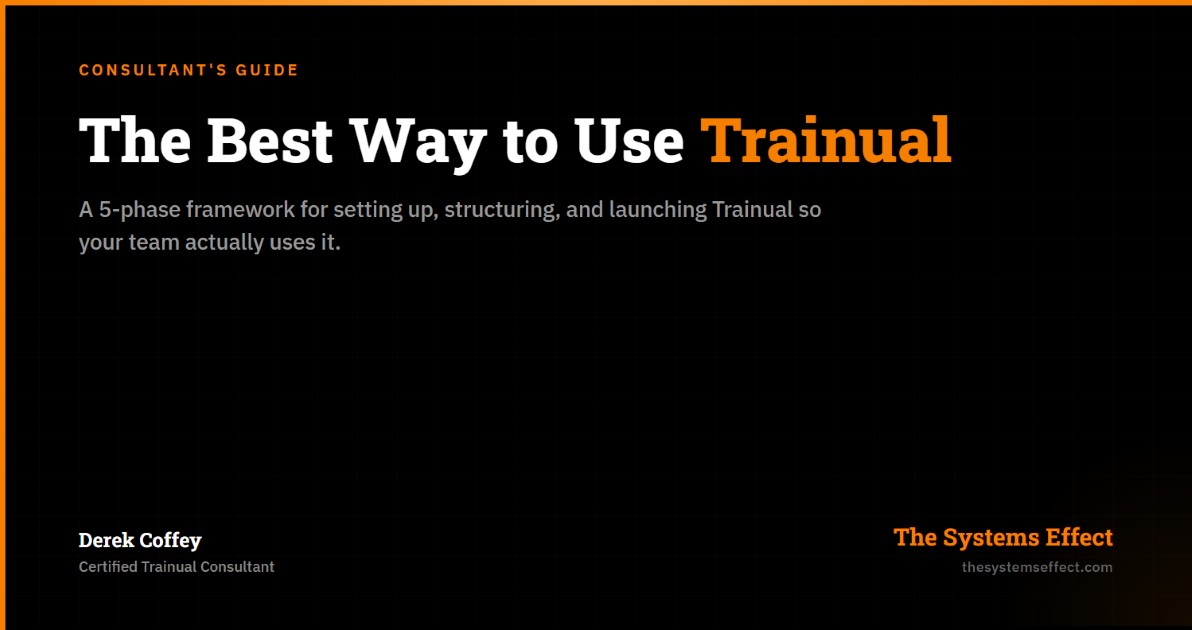
The Best Way to Use Trainual: A Consultant's Guide to Actually Getting ROI

A certified Trainual consultant's playbook for getting real ROI from the platform, covering pre-build planning, role-based content structure, launch accountability, and the quarterly maintenance rhythm that keeps it from becoming shelf-ware.

Your Key Employee Just Resigned. Here's Your 14-Day Knowledge Rescue Plan.

When a key employee resigns, businesses have roughly 14 days to capture their institutional knowledge before it's lost for good. This article lays out a day-by-day plan for recording their decision-making process, not just their tasks, and distributing that knowledge to the team before they leave.